
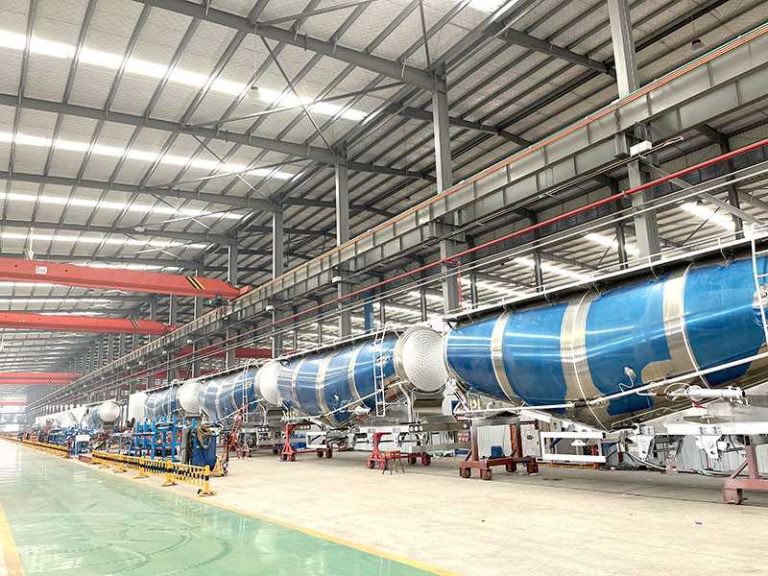
In export trailer sourcing, factory review has moved from visual confidence to execution confidence. Buyers no longer decide from workshop photos and certificate labels alone, because the highest project risk appears after quotation, when technical constraints and delivery promises must be carried into production reality. This is why evaluation now focuses on whether a supplier can keep manufacturing behavior stable under changing project conditions. The core question is no longer "does the factory look capable," but "can the factory execute consistently over time."
From our project experience as a manufacturer, review quality has a direct effect on downstream stability. When technical clarification, process control, quality traceability, and schedule governance are reviewed as one chain, commercial decisions are faster and correction cost is lower. When they are reviewed separately, contradictions are usually found after order confirmation, where every correction becomes more expensive than in RFQ stage. Therefore, practical buyers now prioritize causal verification: what is promised, what controls it, and how it is updated when conditions change.
1) Real manufacturing capability
Real capability is not defined by equipment count but by system fit to project scope. A factory may present strong hardware while still failing execution if process ownership, shift rhythm, and capacity planning are fragmented. For that reason, buyers should test whether workshop resources match the quoted model mix and output cadence under realistic load. Capability is credible only when it remains stable in pressure conditions, not only in demonstration conditions.
In our own project communication, we frame capability through process continuity: material preparation, welding consistency, assembly fit, finishing control, and release criteria. If these stages are governed in one logic, batch stability becomes predictable and lead-time confidence increases. If the chain has weak transitions, quality and schedule drift usually emerge even when individual stations look strong. This is why process linkage is a more reliable indicator than isolated equipment highlights.
A further implication concerns risk forecasting. A mature plant should explain where bottlenecks emerge, how capacity is rebalanced, and which controls protect quality during compressed timelines. If those explanations are missing, production uncertainty is already present, even before PO issuance. In practical sourcing terms, transparency of execution limits is often more valuable than optimistic headline capacity.
2) Technical communication
Technical communication in RFQ phase is a predictive signal for post-order coordination quality. When boundaries for options, structural limits, and market compliance are defined early, engineering and commercial workflows stay aligned. When those boundaries are vague, ambiguity reappears in drawing revision, material release, and timeline negotiation. As a result, schedule loss is usually caused by unresolved technical logic rather than by fabrication speed alone.
A reliable manufacturer should communicate constraints with decision-grade clarity. This means explaining not only feasible configurations, but also conditional risks, change impacts, and non-recommended combinations under route or regulatory pressure. Early clarity helps both parties compare scope, cost, and lead-time on the same assumptions. Without that shared baseline, price discussions become disconnected from deliverability.
Speed and depth must be balanced. Fast but shallow answers shift risk downstream, while deep but delayed answers slow decision windows and create commercial drag. Effective technical communication combines response discipline with engineering precision and keeps one consistent logic across teams. In execution terms, this consistency is what prevents repeated re-clarification cycles later.
3) Quality control and traceability
For project procurement, quality confidence cannot rely on final-pass statements alone. Buyers need to see how inspection checkpoints are embedded in process flow, how deviations are recorded, and how corrective actions are closed with accountability. Without this control chain, each batch behaves like an isolated event and quality claims become difficult to validate. Therefore, quality should be evaluated as process governance rather than end-point outcome.
Traceability becomes even more critical in phased and multi-unit delivery programs. When records connect process stage, nonconformity cause, corrective execution, and release decision, root-cause analysis becomes operational instead of argumentative. When records are disconnected, issue handling shifts from evidence-based correction to responsibility negotiation. The difference directly affects downtime risk, claim exposure, and long-term cooperation stability.
From a manufacturer perspective, traceability also improves collaboration efficiency. It allows both sides to review recurring patterns using shared data rather than memory or assumptions, which shortens resolution cycles and improves prevention planning. Over time, this reduces repeat defects and stabilizes future configuration decisions. In practical terms, traceability is not just a quality tool; it is a coordination infrastructure.
4) Documentation and certificate support
In international projects, documentation readiness is a production-readiness issue, not an administrative afterthought. Certificates, specification files, and compliance references must evolve with technical decisions and commercial scope, because each change modifies what must be validated and communicated. If document flow lags behind execution flow, alignment breaks between quotation, approval, and production release. That misalignment usually surfaces at the most expensive stage of the schedule.
Continuous documentation governance improves both approval speed and execution safety. Buyer-side teams can review current evidence without reconciling inconsistent versions, and factory-side teams can control release criteria with fewer ambiguities. The practical outcome is lower probability of late-stage disputes over “what was agreed.” In this sense, document discipline is a direct indicator of delivery maturity.
Certificate support should be interpreted in the same operational frame. Certificate names matter less than how certificate logic is reflected in daily process controls and project updates. When certificate evidence is mapped to execution records, compliance discussion becomes auditable and decision-ready. When it is not mapped, certificates become static references with limited risk-control value.
5) Lead time and cross-team coordination
Lead-time credibility depends on governance quality across sales, engineering, planning, and production. A single date commitment is not sufficient unless assumptions are explicit: capacity windows, configuration complexity, supply dependencies, and inspection load. Without stated assumptions, lead-time promises are hard to manage and harder to defend when scope changes. Therefore, schedules should be reviewed as controlled models, not as isolated targets.
Cross-team consistency is the decisive factor in schedule stability. If teams optimize locally with different definitions, project risk accumulates silently and appears late as delay or rework. If teams share one execution logic, deviations are identified earlier and corrected at lower cost. This causal relationship is repeatable across projects and is more predictive than nominal cycle claims.
Milestone communication has similar strategic value. Structured update cadence allows buyers to adjust downstream logistics and procurement before variance becomes disruption, while irregular updates force reactive planning under pressure. In long-cycle exports, consistency of updates often matters as much as absolute fabrication speed. Put simply, communication rhythm is part of delivery performance.
Common misjudgments in factory review
Most review failures come from fragmented logic rather than information scarcity. Teams often validate one dimension deeply but do not verify how it interacts with the rest of the execution chain. This creates early confidence and late correction. The patterns below are the most frequent sources of downstream instability:
- Judging capability from presentation quality without validating process rhythm and repeatable output behavior
- Checking certificate labels without confirming how evidence is generated and maintained in daily operations
- Starting price negotiation before technical boundaries and change impacts are fully aligned
- Accepting lead-time commitments without validating assumptions, milestone ownership, and escalation paths
A robust review therefore connects manufacturing feasibility, technical clarity, quality traceability, documentation governance, and schedule control in one causal framework. Only then can early decisions remain valid during execution.
Next step
If your team is shortlisting trailer suppliers, share target market, model scope, compliance priorities, and timeline with project-level detail. We can prepare a focused factory and documentation package that supports technical and commercial review in the same decision cycle. This allows your evaluation to measure execution reliability rather than presentation completeness alone. The objective is to choose a partner that can maintain delivery logic, not just issue quick quotations.
With clearer inputs, we can identify likely risk points early, define response paths before pressure builds, and provide a quotation framework grounded in execution reality. That approach reduces downstream volatility and improves internal approval confidence. In practice, the fastest project is usually the one that resolves execution logic at the beginning.